
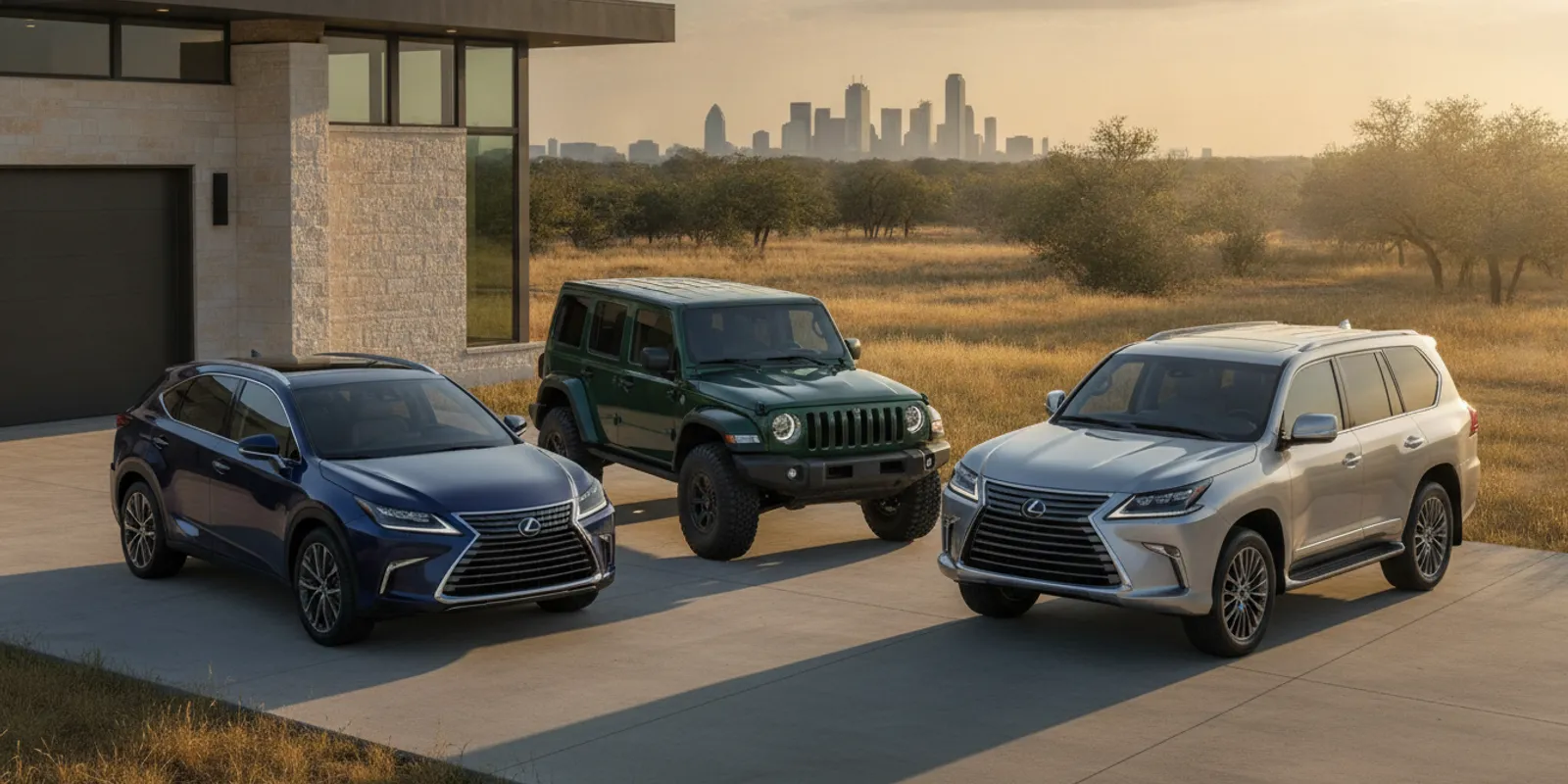
A Lexus 3 row SUV can give a DFW family room for people and luggage without giving up the quiet cabin and polished driving feel expected of a luxury vehicle. Auto Web Expo is in Plano at 4041 West Plano Parkway, Plano, TX 75093; call (469) 626-0777 to discuss your needs. The right choice depends on whether your first priority is everyday passenger space, rough-road capability, or full-size luxury.
Explore Lexus inventory and compare available SUVs for your family.
How do the Lexus TX, GX, and LX differ?
These three SUVs can all serve families, but they are built around different jobs. The TX is the space-first choice for daily family transportation. The GX combines three-row availability in select configurations with a body-on-frame design intended for more demanding terrain. The LX is the large, flagship option, pairing an upscale cabin with substantial capability and a higher level of size and complexity.
That distinction matters more than a badge or a feature list. A family that spends most of its time on school runs, errands, and highway trips may value easy access to the third row and useful cargo space behind it. A driver who regularly travels on unpaved roads may place more importance on a rugged platform. A shopper who wants a full-size luxury SUV may accept a larger footprint in exchange for the LX’s upscale, substantial feel.
Look at exact model years and trims before deciding. Lexus changes equipment and packaging over time, and third-row availability can depend on the model, year, and configuration. Never assume that every GX or LX has the same seating layout. Confirm the vehicle’s actual seat count and equipment on its individual listing.
Which one works best for everyday family space?
Lexus TX: designed around passenger room
The TX entered the lineup for the 2024 model year as a three-row crossover. Its family-first layout makes it a natural starting point when regular use of the third row is central to the decision. It is designed for paved-road family driving rather than the GX’s traditional body-on-frame mission.
For a family with children, pay attention to the details that determine whether the third row is genuinely useful: how easy it is to reach, whether a child seat in the second row blocks access, and how much cargo remains behind the seats. Bring the family’s car seats, strollers, sports bags, or other bulky items to a viewing. A specification sheet cannot tell you whether your own combination of passengers and gear fits comfortably.
The TX 350 uses a turbocharged 2.4-liter four-cylinder engine. The TX 500h is a hybrid performance model, and the TX 550h+ is a plug-in hybrid variant. These are distinct powertrains, not interchangeable trim names. Availability and equipment vary by model year and grade, so compare the exact listing rather than assuming a feature carries across the TX range.
For many DFW households, the TX’s most important benefit is that it treats three-row seating as the core purpose rather than an occasional extra. Consider it first if you regularly carry more than four or five people, want a modern crossover driving position, and expect most trips to be on city streets and highways.
Lexus GX: a more rugged, upright alternative
The current-generation GX returned for the 2024 model year as the GX 550. It uses a body-on-frame construction and a twin-turbocharged 3.4-liter V6. The GX is a better match for drivers drawn to a more upright, rugged SUV, including those who expect to travel on rougher roads or want a more traditional off-road-oriented design.
Do not treat the GX as a TX with different styling. Its proportions, driving character, and priorities are different. The GX may suit a household that values its more rugged construction and wants three-row seating available in an appropriately equipped configuration. However, third-row seating is not universal across every GX year and grade. Check the specific vehicle’s seat count, access, and cargo area before you make plans around carrying seven people.
Think through how often you would actually use its additional capability. If your regular routine is entirely paved roads and your main challenge is fitting passengers and luggage, the TX may be the more natural fit. If an upright cabin, rugged design, and capability beyond ordinary paved commuting are important, the GX deserves a closer look.
Lexus LX: full-size luxury and presence
The LX sits at the flagship end of this group. It is a full-size, body-on-frame SUV that combines a premium cabin with a more substantial road presence and serious capability. It is worth considering when the family wants a large luxury vehicle and values the LX’s distinct combination of refinement and rugged roots.
The LX is not simply a larger TX. Its size and construction make it a different kind of vehicle to maneuver, park, and live with day to day. Third-row seating is configuration-dependent, so confirm the exact seating arrangement on the model-year listing. If the third row will be used every day, test access and comfort with the people who will ride there before choosing the LX over a TX.
For 2025, Lexus added the LX 700h hybrid to the LX range alongside the LX 600. This is a model-year-specific distinction: do not assume a 2024 LX has the later hybrid powertrain. Verify the model year and exact designation on any vehicle you are comparing. The LX may be the right fit when full-size luxury and capability rank above easy parking or a crossover-style family layout.
How do the three SUVs compare?
| Shopping consideration | Lexus TX | Lexus GX | Lexus LX |
|---|---|---|---|
| Basic role | Three-row crossover focused on family passenger space | Rugged body-on-frame SUV with three-row seating in select configurations | Full-size flagship, body-on-frame luxury SUV |
| Model-year starting point for current generation | 2024 | 2024 GX 550 | Current LX 600; LX 700h added for 2025 |
| Powertrain details to compare | TX 350 turbo-four; TX 500h hybrid; TX 550h+ plug-in hybrid | GX 550 twin-turbo 3.4-liter V6 | LX 600 twin-turbo 3.4-liter V6; 2025 LX 700h hybrid |
| Third-row check | Three-row layout is central to the model | Confirm seating by year and grade; not every configuration should be assumed to have a third row | Confirm seating by year and grade; check access and usable space in person |
| Best starting point for | Frequent family trips with several passengers | Drivers who want rugged construction and capability beyond paved-road commuting | Shoppers prioritizing full-size luxury, presence, and capability |
| Key trade-off to consider | Choose the powertrain and equipment that match your needs | Assess whether its rugged strengths fit your daily use and confirm the third-row layout | Make sure the larger footprint and configuration suit your regular routine |
This is a role-based comparison, not a promise that every model or grade has identical equipment. Check each vehicle’s listing for its model year, powertrain, seat count, and included features. A TX 350, TX 500h, and TX 550h+ can differ substantially in powertrain, while a GX or LX’s seating arrangement can depend on its configuration.
Which Lexus powertrain and model year should you compare?
Start with the model year, not a broad model name. The current TX, GX 550, and LX 600 generations began in 2024, but the lineup has evolved. Lexus added the TX 550h+ plug-in hybrid within the TX family and introduced the LX 700h for the 2025 model year. This means a listing’s year and full designation are essential when comparing equipment and powertrains.
With the TX, decide whether the TX 350’s turbocharged engine, the TX 500h hybrid configuration, or the TX 550h+ plug-in hybrid best matches your driving routine. If you are considering a plug-in vehicle, think about whether charging access is convenient where you park. Do not choose solely on the word “hybrid”; compare the actual model and how you plan to use it.
For a GX or LX, identify the exact version and check the equipment list. The GX 550 and LX 600 use twin-turbocharged V6 powertrains, while the 2025 LX 700h adds a hybrid option. Verify the drivetrain, seating arrangement, and features on the specific vehicle. If towing or off-pavement use is part of your plan, check the vehicle’s official specifications for the exact model and configuration rather than relying on a general model-family description.
Model-year accuracy is also important when considering warranty coverage. Remaining factory coverage depends on the vehicle’s age, mileage, original in-service date, and the applicable warranty terms. Ask for the specific vehicle’s history and coverage details; do not infer them from the badge or registration year alone.
What should DFW families test before buying?
A thoughtful test drive should reproduce the family’s real routine. A short loop around the dealership can help you judge steering and visibility, but it will not answer every question about fitting people and cargo. Use a consistent checklist for each candidate:
- Try every row. Have each regular passenger sit in the seat they would use. Check entry, headroom, foot room, and whether the third row is comfortable for the people expected to use it.
- Test seat access. Fold and move the second-row seats. If you use child seats, check whether you can reach the third row without removing one.
- Load your everyday gear. Bring a stroller, sports equipment, work bags, or other items you regularly carry. Check how much space remains when all intended passenger seats are in use.
- Drive familiar roads. Include a stretch of highway, surface streets, and a parking maneuver. Pay attention to ride comfort, visibility, turning, and how the vehicle feels in a space similar to your home garage.
- Try the controls. Adjust the driver’s seating position, climate controls, navigation, and driver-assistance settings. Make sure the systems are straightforward for the people who will use them.
- Compare equipment by VIN and listing. Confirm the model year, trim designation, powertrain, seating, and included features on the individual vehicle. A family’s must-have features can differ even between vehicles with the same model name.
DFW driving involves more than commuting. Consider where you park at home and work, how often you make longer trips, and whether you routinely travel with a full cabin. A large SUV can feel comfortable on the highway yet inconvenient in a tight parking structure. Conversely, choosing the smallest option without testing the third row may create a daily compromise for a growing family.
Make your comparison consistent. Drive each candidate on a similar route, set the driver’s seat to the same comfortable position, and then check the space behind that seat. If the driver is tall, this can quickly show whether a second-row passenger still has enough room. Repeat the test with the third row raised, because a vehicle that fits everyone but leaves no practical room for bags may not solve your family’s main problem.
Also consider which features are genuinely useful to your household. A power liftgate, camera views, charging connections, and climate controls can matter when several people share an SUV, but availability can vary by trim and year. Write down a short list of must-haves before shopping. This keeps a heavily equipped example from distracting you if it does not fit the family’s seating or cargo needs.
What should you check on a pre-owned Lexus?
Start by matching the vehicle to its listing and paperwork. Confirm the VIN, model year, exact powertrain, seating configuration, and odometer reading. Review the available vehicle history and ask about prior use, ownership, and any disclosed repair history. A careful review helps separate a model’s general reputation from the condition and equipment of the individual vehicle.
Inspect the cabin with the family’s needs in mind. Check each seat adjustment, seat belt, door, cargo-area cover, and power-operated feature. Look for signs of wear that matter to your household, such as stains or damage where children or pets are likely to ride. Test climate controls for each row and confirm that the third row folds and returns to position as expected.
Ask for a clear explanation of any warranty coverage and what it includes. Coverage can depend on model year, mileage, and the vehicle’s history. For a hybrid or plug-in hybrid, ask for information specific to that vehicle and verify coverage details rather than assuming that battery terms are identical across models or years.
Auto Web Expo sells pre-owned luxury vehicles and has service capabilities for Lexus. You can review the Lexus inventory, explore pre-owned luxury vehicles in Plano, and read about Lexus service options. If you have questions about financing, see the dealership’s financing information before you compare monthly costs.
How should you choose between the TX, GX, and LX?
Choose the TX if frequent third-row use and everyday passenger space are at the top of your list. It is the most direct match for a household looking for a family-oriented three-row crossover. Narrow down the TX powertrain by comparing the TX 350, TX 500h, and TX 550h+ against your driving and charging habits.
Choose the GX if you value its body-on-frame construction and rugged character, and a correctly equipped example meets your passenger needs. Check the third-row layout on the exact vehicle instead of assuming it is standard. The GX is a more compelling fit when those capability priorities have a real place in your routine, not just because its styling looks adventurous.
Choose the LX if you want a full-size flagship SUV and are comfortable with its larger presence. Confirm seating and equipment by year and grade, then test whether its size works for your parking and daily routes. Compare the LX 600 with the 2025 LX 700h only after verifying the exact model year and powertrain.
Whichever model you consider, let passenger fit, usable cargo space, and the actual vehicle’s equipment make the decision. A test drive with your family and everyday gear can reveal more than comparing names on a page.
Contact Auto Web Expo in Plano to compare Lexus SUVs and arrange a test drive.
Frequently Asked Questions
Which Lexus SUV is designed specifically as a three-row crossover?
The Lexus TX is the lineup’s three-row crossover and is the natural first comparison for families who expect to use all three rows regularly. Still, try the seats and cargo area in person to see whether the layout works for your family.
Does every Lexus GX have a third row?
No. Third-row availability depends on the GX model year and configuration. Check the exact vehicle’s seat count and equipment listing, then test access and passenger space before making a decision.
Is the Lexus LX 700h available for every model year?
No. Lexus introduced the LX 700h for the 2025 model year. Confirm the year and designation on the specific LX you are considering; earlier model years should not be assumed to have that powertrain.
What is the main difference between the Lexus TX and GX?
The TX is a family-oriented crossover focused on passenger room, while the GX is a body-on-frame SUV with a more rugged design and capability emphasis. Think about your typical roads and passenger needs, then compare the exact vehicle configurations.
How can I compare used Lexus three-row SUVs in Plano?
Review the vehicle’s model year, powertrain, seat count, equipment, and condition, then test every row with the people and gear you plan to carry. Auto Web Expo is located at 4041 West Plano Parkway, Plano, TX 75093, and can be reached at (469) 626-0777.