
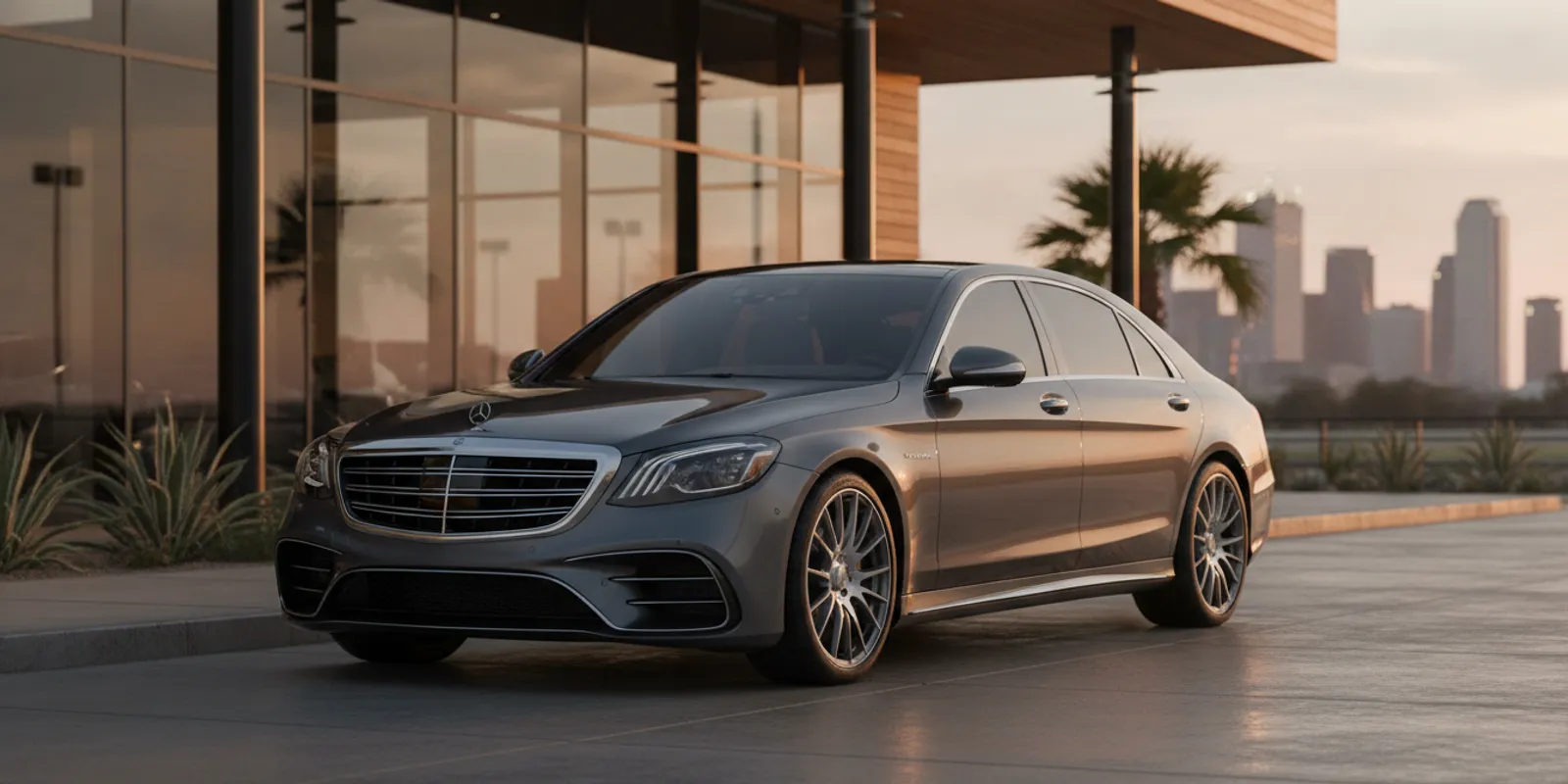
The Mercedes S63 AMG combines full-size S-Class comfort with AMG performance, but the name covers several generations and very different powertrains. For DFW shoppers considering a pre-owned Mercedes S63 AMG, the right choice depends on how you will use the sedan, which features matter most, and how carefully you verify its condition and history.
Explore available Mercedes-Benz S-Class models
What makes the Mercedes-AMG S 63 different?
The S 63 is the high-performance counterpart to the regular S-Class. It pairs a large, quiet luxury sedan cabin with an AMG-developed engine, performance-focused chassis tuning, distinctive trim, and braking hardware suited to its greater output. The exact package changes by generation and model year, so an S 63 badge alone does not tell you every specification.
It is not simply a smaller sports sedan with more power. The S 63 is substantial in size and built to cover distance while carrying passengers in comfort. Its performance character can make everyday driving feel effortless, but the car's weight, complexity, and equipment mean that condition and documented care deserve as much attention as acceleration or styling.
Before comparing listings, clarify what “performance” means to you. You might want strong passing response, a refined commute, a comfortable rear cabin, or a single vehicle that can do all three. Think about parking, local traffic, road surfaces, and whether you often carry passengers. Those answers help you distinguish a well-matched example from one that only looks compelling in photos.
How do the S 63 generations compare?
Shoppers will encounter S 63 models from different S-Class generations. Broadly, the W221 is the earlier generation, the W222 followed it, and the W223 is the current-generation S-Class design. The years overlap in listing and registration details, and equipment can vary by market and build. Confirm a specific car's model year, VIN, original equipment, and powertrain rather than relying on a general generation label.
| Generation / era | What to expect | What to verify |
|---|---|---|
| W221, broadly late 2000s to early 2010s | Earlier S-Class cabin and technology, with V8 configurations that changed during the generation. | Exact engine and model year, age-related condition, service records, and operation of older electronics. |
| W222, broadly mid-2010s to 2020 | A more modern cabin and driver-assistance suite; engine configuration changed during this generation. | Build-specific options, software and feature operation, documented repairs, and the condition of complex systems. |
| W223, introduced in the 2020s | Newer S-Class design and technology; the S 63 E PERFORMANCE adds plug-in hybrid hardware to the AMG package. | Exact model year and powertrain, high-voltage-system information where applicable, charging equipment and records, and remaining coverage. |
This table is a screening aid, not a substitute for a vehicle build sheet. Depending on year and market, the earlier S 63 uses naturally aspirated or turbocharged V8 power, while later versions use different turbocharged V8 configurations. The newer S 63 E PERFORMANCE combines a V8 with plug-in hybrid technology. That is a meaningful ownership difference: buyers should understand the hybrid system and charging arrangements as well as the conventional engine and drivetrain.
Use the model year and VIN to confirm the specific car's engine, driveline, and installed equipment. A listing may use a broad description or omit details. If two cars are close in price, compare their actual equipment and records, not just their generation or advertised features. Browse the dealership's Mercedes-Benz inventory and pre-owned luxury selection in Plano as starting points, then review individual vehicle details for the exact configuration.
When a listing description and the vehicle's equipment seem inconsistent, pause before drawing conclusions. Trim names and option packages can vary, and a seller may use shorthand that is not precise enough to establish what the car has. Ask for a VIN-specific equipment list or window sticker when available, then check the cabin and controls in person. Keep a note of confirmed items and unresolved questions. This small step helps prevent a comparison from turning on a feature that the car does not actually include.
Which performance and cabin features should you compare?
Start with the powertrain and driving setup. Find out which engine is fitted, whether the car has all-wheel drive, and what transmission and performance settings are included. Do not assume every feature is standard across every year. During a test drive, check that the engine starts cleanly, the transmission shifts smoothly, and the vehicle responds consistently in ordinary driving. Drive it long enough to assess low-speed behavior, highway merging, braking, and ride comfort.
Next, evaluate how the car's performance equipment affects comfort. The S 63 may have selectable drive modes and an adaptive suspension, but a mode name is less useful than confirming the car behaves as expected. Listen for unusual suspension or brake noise over uneven pavement, and note any warning messages. A firm or sporty feel can be normal; a clunk, vibration, persistent warning, or uneven response deserves a clear explanation and professional diagnosis.
Plan a test drive in stages instead of making a quick loop around the block. Start with a cold or recently started vehicle if practical and observe the startup, idle, and initial gear engagement. In a quiet area, make gentle turns and use light braking to notice noises or steering pull. On a safe road, accelerate smoothly and assess whether the drivetrain responds without hesitation. Finish on a rougher surface or at low speed over a driveway entrance, where suspension sounds may be easier to notice. Record observations immediately so that different cars do not blur together.
Cabin equipment varies significantly. Check the actual car for the seating configuration and adjustment options, seat heating or ventilation, rear-seat features, audio system, navigation, cameras, driver-assistance functions, and phone connectivity. Test each feature rather than taking a window sticker or online description at face value. Look for missing controls, damaged trim, nonresponsive displays, or features that appear to be disabled.
For a DFW test drive, consider the sedan in the settings where you will use it. Try a parking garage or a tighter parking space if those are part of your routine. On a familiar route, pay attention to visibility, turning feel, braking confidence, cabin noise, and ride comfort over patched pavement. If the rear seats matter, sit there and test access, space, and the controls your passengers would use.
Think through how much of the S 63's equipment you will use. A buyer who regularly carries adults in the rear may value rear-seat comfort and controls more than a particular exterior option. Someone who commutes alone may prioritize driver-seat fit, visibility, and simple access to frequently used settings. Test the controls you expect to use every day, not only the most eye-catching technology. If a feature is unfamiliar, ask for a demonstration and check whether the vehicle retains its instructions or settings information.
What should you inspect before buying a used S 63?
Begin with identity and condition. Match the VIN on the vehicle to the listing and available documents. Review the title and history information, and ask about prior damage, repairs, ownership, and use. A clean-looking exterior cannot establish a car's history. Check body panels in consistent light for mismatched paint, irregular gaps, or evidence of repairs. Inspect the glass, wheels, tires, and underbody for damage or uneven wear.
- Engine and drivetrain: Look for warning lights, fluid seepage, smoke, unusual odors, rough idle, or hesitation. Ask for records that identify relevant repairs and routine care.
- Transmission and drive system: During the drive, note delayed engagement, harsh shifts, vibration, or noises when turning. Have concerns assessed rather than guessing at their cause.
- Brakes and tires: Check remaining tire tread and whether wear is even across each tire. Look for brake vibration, pulsing, squealing, or a pull under braking.
- Suspension: Listen for knocks and creaks, check for uneven ride height, and notice whether the car tracks steadily over bumps.
- Electronics: Test the display, cameras, lights, climate controls, seat adjustments, audio, windows, key functions, and driver-assistance features fitted to that car.
- Interior: Inspect seat bolsters, leather, trim, carpeting, and controls for wear or damage that might not match the stated mileage or overall presentation.
Request records that are specific enough to be useful: dates, mileage, work performed, and invoices or repair orders where available. Ask whether open warning messages or known issues remain, and whether any components have been replaced or modified. A seller's explanation is a starting point; records and a qualified independent inspection provide a stronger basis for a decision.
Read the records in chronological order. Look for gaps in time or mileage, recurring work on the same system, and maintenance entries that do not identify what was actually done. A stack of receipts is most useful when you can connect each document to the vehicle and understand the repair. If a record mentions a warning light, replaced part, or software update, ask what prompted the work and whether the issue returned. Keep unanswered questions on a written list and resolve them before purchase rather than relying on a verbal summary.
Because the S 63 combines high-output mechanical systems with extensive electronics, arrange a pre-purchase inspection by a technician familiar with Mercedes-Benz vehicles and the relevant generation. Ask the inspector to scan for stored diagnostic codes, assess the engine, transmission, suspension and brakes, and review any hybrid components on an S 63 E PERFORMANCE. An inspection cannot promise that a used car will never need repairs, but it can identify concerns to investigate before you commit.
Ask the inspector to document findings in a way you can act on. Separate immediate safety concerns from repairs that may be approaching and cosmetic items that do not affect operation. If the inspection identifies a fault, request a clear explanation of what additional diagnosis is needed, whether the car should be driven, and a written estimate from a qualified shop. This prevents a vague “needs attention” note from becoming either an automatic deal-breaker or an overlooked expense.
As you plan ownership, review the dealership's vehicle service options. Confirm directly which work a particular vehicle may need and what inspection arrangements are available; do not treat a general service page as a substitute for an evaluation of that individual car.
How should you plan for ownership costs?
Purchase price is only one part of the budget. A performance luxury sedan can involve higher costs for tires, brakes, specialized repairs, and equipment than a conventional sedan. The specific amount depends on the car's condition, parts, labor, driving habits, and the work it needs. Avoid assuming that a lower purchase price means lower total ownership cost.
Before making an offer, build a short ownership plan:
- Set a purchase budget: Include taxes, registration, financing costs, and any immediate work identified during inspection.
- Review the car's records: Note what was recently done, what is due by time or mileage, and what documentation is missing.
- Get repair estimates: For any inspection finding, ask a qualified shop to explain urgency and provide a written estimate. Separate safety-related or immediate needs from items to monitor.
- Check coverage: Confirm any remaining manufacturer coverage or other applicable protection in writing, including its dates, limits, and exclusions.
- Compare financing options: Review the amount financed, term, rate, and total payments, not just the monthly figure.
For a more complete budget, get insurance estimates for the exact year and configuration before finalizing a purchase. Ask what deductible and coverage levels are included, and account for any equipment or performance components that may affect a repair estimate. Tire replacement is another item worth pricing in advance: check the size and type fitted to the car, compare suitable replacements, and ask whether all four tires show similar wear. These checks help turn broad expectations into a realistic ownership plan.
An S 63 E PERFORMANCE needs a few additional questions. Confirm that the car's charging equipment and charging functions operate as expected, and ask what records are available for its high-voltage components. Understand how the plug-in system fits your parking and charging routine, rather than treating the hybrid badge as a benefit by itself. If home charging is not practical, consider how often you expect to plug in and whether the vehicle still fits your daily use when you do not. Have a qualified technician inspect the system and explain any coverage that applies to it.
If you expect to finance, Auto Web Expo provides vehicle financing information and an online pre-approval option. Review the terms that apply to your situation and compare them with your budget before choosing a vehicle. If you have a current car to sell or trade, use the dealership's vehicle-selling information to understand that part of the transaction too.
How can DFW buyers compare their finalists?
Compare two or three S 63 examples on the same criteria. An older car with a strong record may be a better fit than a newer one with unclear history, but condition and configuration determine the value of that comparison. Use a simple scorecard, and write down the evidence rather than relying on memory after several test drives.
| Comparison item | Questions to answer | Evidence to collect |
|---|---|---|
| Configuration | Which generation, engine, driveline, and equipment does this car have? | VIN, listing details, build information, and an equipment check in person. |
| Condition | Does it drive, brake, and operate consistently? | Test drive notes and an independent inspection report. |
| History | Are ownership, damage, and repairs documented? | Vehicle history information, records, and answers to specific questions. |
| Near-term needs | What work is due or recommended soon? | Inspection findings, service records, and written estimates. |
| Budget fit | Can you manage the total purchase and likely ownership expenses? | Financing terms, insurance quote, and repair estimates. |
Make sure every comparison uses the same standard. If one listing has recent documentation and another does not, count that as an information gap, not proof that the second car has no issues. If either vehicle has modifications, ask who installed them, whether original parts are available, and whether the changes affect coverage or inspection results.
Add practical fit to the scorecard. Record whether each car's seat and steering adjustments suit you, whether passengers can use the rear cabin comfortably, and whether the technology feels straightforward. Note how each example behaves over the same route and pavement. A vehicle that seems impressive in a brief drive may feel different after repeated stop-and-go traffic, parking maneuvers, or a longer highway trip. A consistent route makes subjective impressions easier to compare.
Then separate must-haves from preferences. A missing feature that matters every day can outweigh a desirable option you may rarely use. For example, a buyer who needs rear-seat controls should verify those functions on the actual car, while a solo commuter may give more weight to front-seat comfort and driver-assistance equipment. Set your priorities before looking at the scorecard results, so a polished presentation or a long options list does not distract from condition and fit.
After narrowing the list, verify current availability and the details on each vehicle page. Auto Web Expo's featured pre-owned vehicles page can help you review available options. For directions and location details before an in-person visit, see the dealership's directions page. Listings change, so confirm the specific car's status before traveling.
Compare available Mercedes-Benz S-Class inventory
Frequently Asked Questions
Is a Mercedes-AMG S 63 suitable as a daily driver?
It can suit a driver who wants a full-size luxury sedan with strong performance, but personal fit depends on parking, traffic, ride preference, and ownership budget. Test the specific car in the conditions you encounter regularly, and account for the cost of maintaining a complex performance vehicle.
Are all Mercedes S 63 AMG model years powered the same way?
No. Engine and drivetrain configurations changed across generations, and the newer S 63 E PERFORMANCE uses plug-in hybrid technology alongside a V8. Verify the model year and VIN-specific equipment for any car you are considering rather than assuming specifications from another year apply.
What records should I request for a pre-owned S 63?
Ask for available maintenance and repair records with dates and mileage, along with information about prior damage, ownership, and modifications. Review the vehicle history information as another source, then have a qualified technician inspect the car and explain any findings.
Should I get an inspection even if the car looks clean?
Yes. A clean appearance cannot reveal every mechanical, electronic, or prior-repair issue. A pre-purchase inspection by a technician familiar with the model can help identify concerns and give you better information before deciding.
A Mercedes-AMG S 63 can deliver a distinctive mix of performance and S-Class comfort, but the best purchase is the one whose exact configuration, condition, records, and ownership costs make sense for you. Compare carefully, verify the details, and base your decision on the individual vehicle rather than the badge alone.